
Access to and Utilization of Maternal and Child Healthcare Services During COVID-19 Pandemic in Rural Bangladesh
DOI:
https://doi.org/10.25259/IJMA_612Keywords:
- COVID-19,
- Access and Utilization of MCH Service,
- Rural Communities,
- Bangladesh,
- Healthcare Access,
- Service Utilization,
- Healthcare Accessibility
Abstract
Geographically remote areas in lower-middle-income countries like Bangladesh experienced significant Maternal and Child Health (MCH) care shortages during the COVID-19 pandemic. These shortages were exacerbated by preexisting inadequate public health infrastructure and using existing health resources for pandemic management. The objective of this study was to assess the status of access to and utilization of maternal and child healthcare services among rural people during the outbreak of COVID-19.
MethodsA community-based descriptive, exploratory, cross-sectional study was carried out from May to August 2020 among the rural people of the four districts of northern Bangladesh. A total of 639 women were included in the study with a sample random sampling technique, and multistage random sampling techniques were applied to select the study area. A pretested semi-structured questionnaire was used for data collection. SPSS Version 22 was used for the statistical analysis.
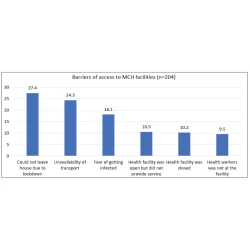
ResultsThe mean age of the respondents was 34.3 years with an SD ± 10 years. 37.7% of respondents belonged to the 21–30 year age group followed by the 31–40 years age group (34.9 %). Of the total 639 respondents, 59.5% were female. There were significant associations and moderate positive correlations between educational qualification, occupational status, and age group of the respondents (p=0.001). Most of the respondents (67.6%) indicated that they experienced health problems during COVID-19 with 70.6% of them specifically mentioning MCH-related problems. Out of them, only 33.1% mentioned they could access and utilize MCH services, whereas 66.9% of them could not access MCH Services. Major barriers to utilizing MCH services were the COVID-19 lockdown, lack of transport facilities, fear of being infected, shutdown of healthcare facilities, and unavailability of healthcare professionals. The differences in health facility usage before and during COVID-19 are statistically significant with p = < 0.001.
Conclusion and Global Health ImplicationsDuring the COVID-19 pandemic, access to and utilization of MCH services was significantly hampered, particularly in Bangladesh’s remote and rural regions during the strict lockdown times. The identified barriers were the COVID-19 lockdown, lack of transport facilities, fear of being infected, shutdown of healthcare facilities, and unavailability of healthcare professionals. Building strengthened health systems, capacity building of informal healthcare providers, backup plans, and alternate service delivery models are necessary to ensure access to maternity and child health.
RecommendationsFor future pandemics and natural disaster situations, the ‘concerned officials should strategically have backup plans and alternative service delivery models to strengthen the health system. And, there should be collaborative efforts among the countries to support each other to address the crisis situations.
Downloads
Similar Articles
- Océane J. Parker, Duc Minh Duong, Thuy Thu Nguyen, Vui Thi Le, Utilization of Sexual and Reproductive Healthcare Services Among Young Women in Two Districts of Hanoi, Vietnam , Vol. 15 (2026): International Journal of Maternal and Child Health and AIDS
- Charles Chibuisi Ehiemere, Ishaku Adamu Akyala, Bisayo Adetuyi Ogundipe, Chukwuebuka Clement Nri-Ezedi, Peter Joseph Anzaku, Waryit Esther Yonah, Efe Mary Imokhai, Isaac Onyebuchi Okohu, Idowu Olapemi Makinde, Ngozi Miriam Chimzobam-Nnalue, Beyond Access: Behavior Change and Gendered Realities in the Adoption of Digital Health Tools for Maternal, Newborn, and Child Health in Nigeria , Vol. 15 (2026): International Journal of Maternal and Child Health and AIDS
- Maria Vigil-Mallette, Daryle Pickens, Julliet Ogu, Deepa Dongarwar, Elizabeth Onugha, Hamisu M Salihu, Fifth Annual Summer Research Summit on Health Equity Organized by the Center of Excellence in Health Equity, Training and Research, Baylor College of Medicine, Houston, Texas 77030, USA on May 17, 2022 , Vol. 11 No. S2 (2022): International Journal of Maternal and Child Health and AIDS
- Zubairu Iliyasux, Amina A. Umar, Fatima S. Gaya, Nafisa S. Nass, Hadiza M. Abdullahi, Aminatu A. Kwaku, Taiwo G. Amole, Fatimah I. Tsiga-Ahmed, Hadiza S. Galadanci, Hamisu M. Salihu, Muktar H. Aliyu, ‘We delivered at home out of fear’: Maternity Care in Rural Nigeria During the COVID-19 Pandemic , Vol. 12 No. 1 (2023): International Journal of Maternal and Child Health and AIDS
- Margaret Omowaleola Akinwaare, Jonah Musa, Chizoma Millicent Ndikom, Determinants of Digitalized Antenatal Education Use among Pregnant Women Living with Human Immunodeficiency Virus in Nigeria , Vol. 15 (2026): International Journal of Maternal and Child Health and AIDS
- Veronicah A. Wechuli, Monicah W. Karara, Allan T. Wafula, Godfrey W. Mayoka, Impact of COVID-19 on the Utilization of Maternal and Child Health Services at a Regional Referral Hospital in Kenya , Vol. 13 No. Continuous (2024): International Journal of Maternal and Child Health and AIDS
- Deepa Dongarwar, Toi B. Harris, Hamisu M. Salihu, Fourth Annual Summer Research Summit on Health Equity Organized by the Center of Excellence in Health Equity, Training and Research, Baylor College of Medicine, Houston, Texas 77030, USA on May 20, 2021 , Vol. 10 No. S3 (2021): International Journal of Maternal and Child Health and AIDS
- Gopal K. Singh, Hyunjung Lee, Romuladus E. Azuine, Marked Disparities in COVID-19 Vaccination among US Children and Adolescents by Racial/Ethnic, Socioeconomic, Geographic, and Health Characteristics, United States, December 2021 – April 2022 , Vol. 11 No. 2 (2022): International Journal of Maternal and Child Health and AIDS
- Amol Jamkhande, Bhagyashree P. Agre, Neelam Gavali, Anjali Rajesh Gaikwad, Sanpreet Singh Sachdev, Association Between Maternal Periodontitis and Preterm Low Birth Weight in Indian Populations: A Literature Review , Vol. 15 (2026): International Journal of Maternal and Child Health and AIDS
- Wah Wah Myint, Human Immunodeficiency Virus (HIV) Knowledge and Stigma: Findings from a Cross-sectional Survey , Vol. 15 (2026): International Journal of Maternal and Child Health and AIDS
You may also start an advanced similarity search for this article.
Published
How to Cite
Issue
Section
License
Copyright © 2024 Matiur Rahman, Kaoser Bin Siddique, Aminur Rahman, Rahidul Islam, Mohammad Mahbub Ur Rahim. Published by Global Health and Education Projects, Inc., USA.

This is an open-access article distributed under the terms of the Creative Commons Attribution-NonCommercial-ShareAlike 4.0 International License , which permits others to remix, transform, and build upon the work non-commercially, provided the original author is credited and the new creations are licensed under the same terms.