
Birth Preparedness Plans and Status Disclosure Among Pregnant Women Living with HIV Who are Receiving Antiretroviral Therapy in Ibadan, Southwest, Nigeria
DOI:
https://doi.org/10.21106/ijma.613Keywords:
- HIV,
- PMTCT,
- Pregnancy,
- Maternal Health,
- Antenatal Care
Abstract
Promoting the maternal health of pregnant women who are living with human immunodeficiency virus (HIV; [PWLH]) is key to reducing maternal mortality and morbidity. Thus, inadequate birth preparedness plans, non-institutional delivery, and status concealment among PWLH contribute to the spread of HIV infection and threaten the prevention of mother-to-child transmission (PMTCT). Therefore, this study aimed to assess the birth preparedness plan and status disclosure among PWLH, as well as the prevalence of HIV infection among pregnant women.
Methods:The study adopted a descriptive cross-sectional research design; a quantitative approach was used for data collection. Three healthcare facilities that represented the three levels of healthcare institutions and referral centers for the care of PWLH in the Ibadan metropolis were selected for the recruitment process. A validated questionnaire was used to collect data from 77 participants within the targeted population. Ethical approval was obtained prior to the commencement of data collection.
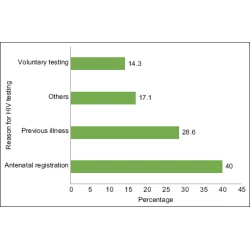
Results:The prevalence rate of HIV infection among the participants was 3.7%. Only 37.1% of the participants had a birth preparedness plan. A total of 40% of the participants tested for HIV, because testing was compulsory for antenatal registration. Only 7.1% of the participants had their status disclosed to their partners. Although 90% of the participants proposed delivering their babies in a hospital, only 80% of these participants had their status known in their proposed place of birth.
Conclusion and Global Health Implications:The prevalence of HIV infection among pregnant women is very low, which is an indication of improved maternal health. However, the level of birth preparedness plan and status disclosure to partners are equally low, and these factors can hinder PMTCT. Institutional delivery should be encouraged among all PWLH, and their HIV status must be disclosed at their place of birth.
Downloads
Most read articles by the same author(s)
- Margaret Omowaleola Akinwaare, Jonah Musa, Chizoma Millicent Ndikom, Determinants of Digitalized Antenatal Education Use among Pregnant Women Living with Human Immunodeficiency Virus in Nigeria , International Journal of Maternal and Child Health and AIDS: Vol. 15 (2026): International Journal of Maternal and Child Health and AIDS
Similar Articles
- Ernest Tambo, Chidiebere E. Ugwu, Yayi Guan, Ding Wei, Xiao-Ning, Zhou Xiao-Nong, China-Africa Health Development Initiatives: Benefits and Implications for Shaping Innovative and Evidence-informed National Health Policies and Programs in Sub-saharan African Countries , Vol. 5 No. 2 (2016): International Journal of Maternal and Child Health and AIDS
- Elizabeth Armstrong, Priya Srinivasan, Dawood Azeemy, Fayja Habib, Ernest Alema-Mensah, COVID-19 Stressors and Maternal Mental Health in Georgia, United States: Sources, Effects, and Recommendations , Vol. 14 No. Continuous (2025): International Journal of Maternal and Child Health and AIDS
- John Humphrey, James G Carlucci, Esther Karen Wanjama, Violet Naanyu, Lindah Muli, Joy Marsha Alera, Edwin Were, Alan McGuire, Winstone Nyandiko, Gregory Zimet, Julia Jerono Songok, Kara Wools Kaloustian, Implementing WHO Differentiated Service Delivery Model for Pregnant and Breastfeeding Women and Infants Living with HIV: Insights from Kenyan Healthcare Providers , Vol. 14 No. Continuous (2025): International Journal of Maternal and Child Health and AIDS
- Ndidiamaka Amutah-Onukagha, Monica Rodriguez, Ijeoma Opara, Michelle Gardner, Maame Araba Assan, Rodney Hammond, Jesus Plata, Kimberly Pierre, Ehsan Farag, Progresses and challenges of utilizing traditional birth attendants in maternal and child health in Nigeria , Vol. 6 No. 2 (2017): International Journal of Maternal and Child Health and AIDS
- Charles Ikeanyionwu, Deepa Dongarwar, Zenab Yusuf, Rafeek Yusuf, Meishon Bell, Toi Harris, Hamisu M. Salihu, 2019 Health Equity Summer Research Summit Organized by the Center of Excellence in Health Equity, Training and Research, Baylor College of Medicine, Houston, Texas 77030, USA on June 18th, 2019 , Vol. 9 No. S1 (2020): International Journal of Maternal and Child Health and AIDS
- Wah Myint, Aishatu Yusuf, Angela Nguyen, Elfreda Samman, HIV Testing, Household and Reproductive Health Decision-Making: The Role of Women Autonomy in a Nationally Representative Study in Cambodia , Vol. 14 No. Continuous (2025): International Journal of Maternal and Child Health and AIDS
- George Chidi Anwuri, Michael S. Dunn, Frederick Schulze, Determinants of Voluntary HIV/AIDS Counseling and Testing among Community College Students in the United States , Vol. 6 No. 2 (2017): International Journal of Maternal and Child Health and AIDS
- Abubakar Sadiq Umar, Lusamba Kabamba, Maternal Mortality in the Main Referral Hospital in Angola, 2010-2014: Understanding the Context for Maternal Deaths Amidst Poor Documentation , Vol. 5 No. 1 (2016): International Journal of Maternal and Child Health and AIDS
- May Soe Aung, Myint Moh Soe, Hla Hla Win, Kyaw Swa Mya, Assessing the Impact of an Intervention on Caregivers’ Awareness and Completion of Continuum of Care Among Pregnant Women , Vol. 13 No. Continuous (2024): International Journal of Maternal and Child Health and AIDS
- Mary Stokes, Amber Olson, Mtisunge Chan’gombe, Bakari Rajab, Rachel Pope, Carolyn Mwalwanda, Judy Levison, Isabel Janmey, Reinventing the Pregnancy Wheel to Improve Pregnancy Dating and Antenatal Care Visits: A Pilot Randomized Trial in Malawi , Vol. 10 No. 1 (2021): International Journal of Maternal and Child Health and AIDS
<< < 1 2 3 4 5 6 7 8 9 10 > >>
You may also start an advanced similarity search for this article.
Published
How to Cite
Issue
Section
License
Copyright © 2024 Margaret Omowaleola Akinwaare, Funmilayo A. Okanlawon, Monisola A. Popoola, Omotayo O. Adetunji. Published by Global Health and Education Projects, Inc., USA.

This is an open-access article distributed under the terms of the Creative Commons Attribution-NonCommercial-ShareAlike 4.0 International License , which permits others to remix, transform, and build upon the work non-commercially, provided the original author is credited and the new creations are licensed under the same terms.