
Postpartum Hemorrhage in Humanitarian Settings: Heat-Stable Carbetocin and Tranexamic Acid Implementation Study in Uganda
DOI:
https://doi.org/10.25259/IJMA_9_2023Keywords:
- Health Services Research,
- Postpartum Hemorrhage,
- Heat-Stable Carbetocin,
- Tranexamic Acid,
- Public Health Intervention Package,
- Humanitarian Settings,
- Fragile Settings
Abstract
Postpartum hemorrhage (PPH) remains a major concern in crisis-affected settings. There is a lack of strategies for implementing heat-stable carbetocin (HSC) and tranexamic acid (TXA) in humanitarian settings. This study aims to investigate the impact of a capacity-strengthening package on the utilization of uterotonics for PPH prevention, PPH detection, and utilization of TXA for PPH treatment in basic obstetric care clinics in humanitarian settings in Uganda.
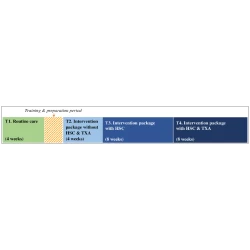
MethodsA multi-stepped implementation research study was conducted, wherein six select facilities utilized an intervention package encompassing provider training, an online community of practice, and wall-displayed PPH algorithms. Facilities were conveniently assigned to the same study sequence: T1 (routine care), a transition period for training; T2 (package without HSC and TXA); T3 (package with HSC); and T4 (package with HSC and TXA). The primary outcomes assessed trends in prophylactic uterotonic use (including HSC), visual diagnosis of hemorrhage, and HSC and TXA use for hemorrhage treatment. Analysis followed an intention-to-treat approach, adjusting for cluster effect and baseline characteristics. Pan-African Clinical Trials Registry: PACTR202302476608339.
ResultsFrom April 10, 2022, to April 4, 2023, 2299 women were recruited (T1: 643, T2: 570, T3: 580, T4: 506). Over 99% of all women received prophylactic uterotonics across the four phases, with oxytocin alone primarily used in T1 (93%) and T2 (92%) and HSC alone in T3 (74%) and T4 (54%) (T4–T1 95% CI: 47.8–61.0). Hemorrhage diagnosis ranged from 1% to 4%. For hemorrhage treatment, universal oxytocin use in T1 and T2 decreased in T3 and T4 after HSC introduction (T4–T1: 33%–100%; 95% CI: –100.0 to –30.9), and TXA use increased in T4 (T4–T1: 33%–0%; 95% CI: –2.4 to 69.1).
Conclusion and Global Health ImplicationsAn intervention package to reinforce providers’ capacity to prevent and treat PPH can result in substantial HSC utilization and a moderate TXA adoption in cold-chain-challenged humanitarian settings. It could be scaled up with continuous capacity development and supportive supervision to mitigate confusion between existing and new medications, such as the decreased use of oxytocin for PPH treatment. Maintaining investments in cold-chain strengthening remains critical to ensure the quality of oxytocin.
Downloads
Most read articles by the same author(s)
- Nguyen Toan Tran, Kidza Mugerwa, Awatta Walter Ochan, Sarah Muwanguzi, Jemelia Sake, Richard Mwesigwa, Okpwoku Sukere, Catrin Schulte-Hillen, Postpartum Hemorrhage in Humanitarian Settings: Implementation Insights from Using Heat-Stable Carbetocin and Tranexamic Acid , International Journal of Maternal and Child Health and AIDS: Vol. 13 No. S1 (2024): International Journal of Maternal and Child Health and AIDS
- Nguyen Toan Tran, Awatta Walter Ochan, Jemelia Sake, Okpwoku Sukere, Willibald Zeck, Armando Seuc, Catrin Schulte-Hillen, Postpartum Hemorrhage in Humanitarian Settings: Heat-Stable Carbetocin and Tranexamic Acid Implementation Study in South Sudan , International Journal of Maternal and Child Health and AIDS: Vol. 13 No. S1 (2024): International Journal of Maternal and Child Health and AIDS
- Alice Rosmini, Kidza Mugerwa, Awatta Walter Ochan, Sarah Muwanguzi, Jemelia Sake, Richard Mwesigwa, Okpwoku Sukere, Catrin Schulte-Hillen, Nguyen Toan Tran, Empowering Midwives in Humanitarian Settings: Integrating Heat-Stable Carbetocin and Tranexamic Acid into Postpartum Hemorrhage Training , International Journal of Maternal and Child Health and AIDS: Vol. 13 No. S1 (2024): International Journal of Maternal and Child Health and AIDS
Similar Articles
- Charles Chibuisi Ehiemere, Ishaku Adamu Akyala, Bisayo Adetuyi Ogundipe, Chukwuebuka Clement Nri-Ezedi, Peter Joseph Anzaku, Waryit Esther Yonah, Efe Mary Imokhai, Isaac Onyebuchi Okohu, Idowu Olapemi Makinde, Ngozi Miriam Chimzobam-Nnalue, Beyond Access: Behavior Change and Gendered Realities in the Adoption of Digital Health Tools for Maternal, Newborn, and Child Health in Nigeria , Vol. 15 (2026): International Journal of Maternal and Child Health and AIDS
- Maria Vigil-Mallette, Daryle Pickens, Julliet Ogu, Deepa Dongarwar, Elizabeth Onugha, Hamisu M Salihu, Fifth Annual Summer Research Summit on Health Equity Organized by the Center of Excellence in Health Equity, Training and Research, Baylor College of Medicine, Houston, Texas 77030, USA on May 17, 2022 , Vol. 11 No. S2 (2022): International Journal of Maternal and Child Health and AIDS
- Océane J. Parker, Duc Minh Duong, Thuy Thu Nguyen, Vui Thi Le, Utilization of Sexual and Reproductive Healthcare Services Among Young Women in Two Districts of Hanoi, Vietnam , Vol. 15 (2026): International Journal of Maternal and Child Health and AIDS
- Amol Jamkhande, Bhagyashree P. Agre, Neelam Gavali, Anjali Rajesh Gaikwad, Sanpreet Singh Sachdev, Association Between Maternal Periodontitis and Preterm Low Birth Weight in Indian Populations: A Literature Review , Vol. 15 (2026): International Journal of Maternal and Child Health and AIDS
- Margaret Omowaleola Akinwaare, Jonah Musa, Chizoma Millicent Ndikom, Determinants of Digitalized Antenatal Education Use among Pregnant Women Living with Human Immunodeficiency Virus in Nigeria , Vol. 15 (2026): International Journal of Maternal and Child Health and AIDS
- Olatunde Ayodele Amode, Damilola Kafayat Oyedele, Hadiza Salele, Olajumoke Adekeye, Uchenna Igbokwe, Lola Ameyan, Kayode Akin Afolabi, Olufunke Fasawe, Owens Wiwa, Cost-effectiveness and Budget Impact of Introducing Heat-stable Carbetocin for Postpartum Hemorrhage Prevention in Nigeria , Vol. 14 No. Continuous (2025): International Journal of Maternal and Child Health and AIDS
- Deepa Dongarwar, Toi B. Harris, Hamisu M. Salihu, Fourth Annual Summer Research Summit on Health Equity Organized by the Center of Excellence in Health Equity, Training and Research, Baylor College of Medicine, Houston, Texas 77030, USA on May 20, 2021 , Vol. 10 No. S3 (2021): International Journal of Maternal and Child Health and AIDS
- Wah Wah Myint, Human Immunodeficiency Virus (HIV) Knowledge and Stigma: Findings from a Cross-sectional Survey , Vol. 15 (2026): International Journal of Maternal and Child Health and AIDS
- Gopal K. Singh, Gem P. Daus, Michelle Allender, Christine T. Ramey, Elijah K. Martin, Chrisp Perry, Andrew A. De Los Reyes, Ivy P. Vedamuthu, Social Determinants of Health in the United States: Addressing Major Health Inequality Trends for the Nation, 1935-2016 , Vol. 6 No. 2 (2017): International Journal of Maternal and Child Health and AIDS
- Ernest Tambo, Chidiebere E. Ugwu, Yayi Guan, Ding Wei, Xiao-Ning, Zhou Xiao-Nong, China-Africa Health Development Initiatives: Benefits and Implications for Shaping Innovative and Evidence-informed National Health Policies and Programs in Sub-saharan African Countries , Vol. 5 No. 2 (2016): International Journal of Maternal and Child Health and AIDS
You may also start an advanced similarity search for this article.
Published
How to Cite
Issue
Section
License
Copyright © 2024 Nguyen Toan Tran, Kidza Mugerwa, Sarah Muwanguzi, Richard Mwesigwa, Damien Wasswa, Willibald Zeck, Armando Seuc, Catrin Schulte-Hillen. Published by Global Health and Education Projects, Inc., USA.

This is an open-access article distributed under the terms of the Creative Commons Attribution-NonCommercial-ShareAlike 4.0 International License , which permits others to remix, transform, and build upon the work non-commercially, provided the original author is credited and the new creations are licensed under the same terms.