
Theory-Driven, Multi-Stage Process to Develop a Culturally-Informed Anti-Stigma Intervention for Pregnant Women Living with HIV in Botswana
DOI:
https://doi.org/10.21106/ijma.569Keywords:
- HIV,
- Stigma,
- Culture,
- Matrescence,
- Intervention,
- Botswana,
- Qualitative Methods,
- Theory,
- Cognitive Behavioral Therapy
Abstract
Background and Objectives: Despite a well-established universal HIV diagnosis and treatment program, Botswana continues to face a high HIV prevalence, in large part due to persistent stigma, which particularly affects pregnant women and interferes with healthcare engagement. Tackling stigma as a fundamental cause of HIV disparities is an important but understudied aspect of current HIV interventions. Our multinational and multicultural team used a theory-driven, multi-stage iterative process to develop measures and interventions to first identify and then target the most culturally-salient aspects of stigma for mothers living with HIV in Botswana. This methodology report examines the stage-by-stage application of the “What Matters Most” (WMM) theory and lessons learned, sharing a replicable template for developing culturally-shaped antistigma interventions.
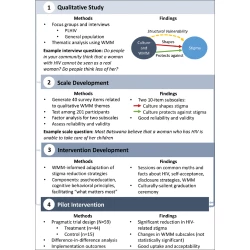
Methods: First, we conducted initial qualitative work based on the WMM theory to identify key structural and cultural factors shaping stigma for women living with HIV in Botswana. Second, we developed a psychometrically validated scale measuring how “what matters most” contributes to and protects against stigma for this population. Third, we designed an anti-stigma intervention, “Mothers Moving towards Empowerment” (MME), centered on the local values identified using WMM theory that underly empowerment and motherhood by adapting a cognitive behavioral therapy (CBT)-informed, group-based, and peer-co-led anti-stigma intervention specifically for pregnant women living with HIV. Fourth, we conducted a pilot study of MME in which participants were allocated to two trial arms: intervention or treatment-as-usual control.
Results: Our qualitative research identified that bearing and caring for children are capabilities essential to the concept of respected womanhood, which can be threatened by a real or perceived HIV diagnosis. These values informed the development and validation of a scale to measure these culturally-salient aspects of stigma for women living with HIV in Botswana. These findings further informed our intervention adaptation and pilot evaluation, in which the intervention group showed significant decreases in HIV stigma and depressive symptoms compared to the control group. Participants reported overcoming reluctance to disclose their HIV status to family, leading to improved social support.
Conclusion and Global Health Implications: Previous studies have not utilized culturally-based approaches to assess, resist, and intervene with HIV-related stigma. By applying WMM in each stage, we identified cultural and gendered differences that enabled participants to resist HIV stigma. Focusing on these capabilities that enable full personhood, we developed an effective culturally-tailored anti-stigma intervention for pregnant women living with HIV in Botswana. This theory-driven, multi-stage approach can be replicated to achieve stigma reduction for other outcomes, populations, and contexts.
Downloads
Similar Articles
- Alexander Suuk Laar, Veioshnee Govender, Individual and Community Perspectives, Attitudes, and Practices to Mother-to-Child-Transmission and Infant Feeding among HIV-Positive Mothers in Sub-Saharan Africa: A Systematic Literature Review , Vol. 2 No. 1 (2013): International Journal of Maternal and Child Health and AIDS
- Zubairu Iliyasu, Fatimah Hassan-Hanga, Sadiq Isah Ajuji, Musa M. Bello, Safiyya S. Abdulkadir, Nafisa S. Nass, Hamisu M. Salihu, Muktar H. Aliyu, Correlates of Health Care Workers’ Knowledge and HIV-Exposed Infant Immunization Counseling Practice in Northern Nigeria , Vol. 10 No. 1 (2021): International Journal of Maternal and Child Health and AIDS
- Oluwasola Stephen Ayosanmi, Lorette Oden, Titilope Ayosanmi, Babatunde Y. Alli, Mei Wen Wen, Jamie Johnson, Acceptability of HIV Screening in a Sample of International Students in the United States , Vol. 9 No. 3 (2020): International Journal of Maternal and Child Health and AIDS
- Ahmad Abdulhadi, Nasiru Abdullahi, Ibrahim Yusuf, Basheer I. Waziri, Kasimu Mamuda , Husna F. Ibrahim, Khadija Muhammad, Maryam M. Ibrahim , Aisha A. Abdullahi, Hassan A. Murtala, Muhammad A. Abbas, Hamisu M. Salihu, A Systematic Review and Meta-analysis on Innovative Approaches in Tuberculosis Diagnosis: Challenges and Future Directions , Vol. 15 (2026): International Journal of Maternal and Child Health and AIDS
- Alicia E. Hersey, Betty Norman, Rebecca Reece, Assessing Reproductive Decision-making Among HIV-Positive Women in Kumasi, Ghana , Vol. 8 No. 1 (2019): International Journal of Maternal and Child Health and AIDS
- Anays Murillo, Mary Bachman DeSilva, Lora L. Sabin, Nafisa Halim, Harriet Chemusto, Philip Aroda, Julia Gasuza, Davidson H. Hamer, Anna Larson Williams, Barbara Mukasa, Lisa J. Messersmith, Rachael Bonawitz, Impact of a Maternal Prevention of Mother-to-child Transmission of HIV (PMTCT) Intervention on HIV-exposed Infants in Uganda , Vol. 9 No. 3 (2020): International Journal of Maternal and Child Health and AIDS
- Charles Kouanfack, Skinner Nguefack Lekelem, Fala Bede, Claude Ngwayu Nkfusai, Yvette Micha Nouafo, Christian Tchokonte, Nicaise Tsomo Zephirin, Pierre Joseph Fouda, Use of Trained Non-Medical Staff to Improve Access to HIV Testing Services in Africa: Implementation of the World Health Organization Opt-out Approach in Cameroon , Vol. 10 No. 1 (2021): International Journal of Maternal and Child Health and AIDS
- Chaw Hay Thar, Young Hwa Lee, Young June Choe, Human Immunodeficiency Virus/Acquired Immunodeficiency Syndrome Knowledge and Attitude among Myanmar Women , Vol. 13 No. Continuous (2024): International Journal of Maternal and Child Health and AIDS
- Alana F. Hairston, Emily A. Bobrow, Christian S. Pitter, Towards the Elimination of Pediatric HIV: Enhancing Maternal, Sexual, and Reproductive Health Services , Vol. 1 No. 1 (2012): International Journal of Maternal and Child Health and AIDS
- Cedrina L. Calder, Heather O’Hara, Mohammad Tabatabai, Celia J. Maxwell, Salisha Marryshow, Aima A. Ahonkhai, Carolyn M. Audet, C. William Wester, Muktar H. Aliyu, Adherence to Combination Antiretroviral Therapy among Pregnant Women Enrolled in a HIV Prevention Program in Rural North-central Nigeria , Vol. 9 No. 1 (2020): International Journal of Maternal and Child Health and AIDS
<< < 1 2 3 4 5 6 7 8 9 10 > >>
You may also start an advanced similarity search for this article.
Published
How to Cite
Issue
Section
License
Copyright © 2022 Ohemaa B. Poku, Timothy D. Becker, Shathani Rampa, Supriya Misra, Ari R. Ho-Foster, Patlo Entaile, Charisse Tay, Karen Choe, Tonya Arscott-Mills, Michael B. Blank, Philip Renison Opondo, Lawrence H. Yang. Published by Global Health and Education Projects, Inc., USA.

This is an open-access article distributed under the terms of the Creative Commons Attribution-NonCommercial-ShareAlike 4.0 International License , which permits others to remix, transform, and build upon the work non-commercially, provided the original author is credited and the new creations are licensed under the same terms.