
Introduction of Heat-Stable Carbetocin through a Public-Private Partnership Model in India: A Retrospective Study to Determine Feasibility and Its Optimal Use in Public Health Settings
DOI:
https://doi.org/10.25259/IJMA_11_2023Keywords:
- Postpartum Hemorrhage,
- Heat-Stable Carbetocin,
- Uterotonic,
- Active Management of Third Stage of Labor,
- Maternal Health
Abstract
The optimal use of oxytocin for preventing postpartum hemorrhage (PPH) faces challenges in many low-middle income countries (LMICs) owing to its storage and transportation prerequisites. We demonstrated Heat-Stable Carbetocin (HSC) for PPH prevention through an innovative Public-Private Partnership (PPP) model in 15 public health facilities of the Dewas District of Madhya Pradesh (MP) state in India. This study evaluates the feasibility and appropriate utilization of HSC in public health settings.
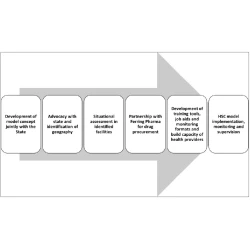
MethodsWe analyzed facility-level data collected between August 2022 and July 2023 from selected 15 health facilities, where HSC was introduced. Prior to the introduction of HSC, all healthcare providers received training on Active Management of the Third Stage of Labor (AMTSL), use of HSC, and recording and reporting procedures. The supply of HSC in health facilities was ensured, and a robust mechanism was set up to monitor the progress.
ResultsA total of 18,497 women were admitted for delivery in the 15 selected facilities. Uterotonic administration within one minute of delivery was almost universal (99.9%). No instance was recorded of using HSC either for induction of labor or management of PPH. In 636 cases (3.43%), HSC was not given for PPH prevention. Pearson’s chi-square test was conducted to assess the relationship between HSC usage and the health facility’s level. The HSC use was significantly higher in First Referral Unit (FRU) facilities compared to non-FRUs (p < 0.001). Moreover, the administration of HSC within one minute of delivery was also more prevalent in FRU facilities compared to non-FRUs (p < 0.001). The PPH incidence and case referral rates noted in this study were 0.7% and 16.7%, respectively, with no reported adverse drug events or deaths.
Conclusion and Global Health ImplicationsOur study suggests the safe and appropriate use of HSC within India’s public health system.
Downloads
Most read articles by the same author(s)
- Varun Alwadhi, Naresh Chandra Joshi, Prashant Kumar Saboth, Raghavendra Narayan Mishra, Kuldeep Martolia, Saurabh Bhargava, Sachin Gupta, Harish Kumar, Management of Newborn Respiratory Distress Using CPAP: Capacity and Readiness of Public Health Facilities in High-Focus Aspirational Districts of India , International Journal of Maternal and Child Health and AIDS: Vol. 14 No. Continuous (2025): International Journal of Maternal and Child Health and AIDS
Similar Articles
- Charles Chibuisi Ehiemere, Ishaku Adamu Akyala, Bisayo Adetuyi Ogundipe, Chukwuebuka Clement Nri-Ezedi, Peter Joseph Anzaku, Waryit Esther Yonah, Efe Mary Imokhai, Isaac Onyebuchi Okohu, Idowu Olapemi Makinde, Ngozi Miriam Chimzobam-Nnalue, Beyond Access: Behavior Change and Gendered Realities in the Adoption of Digital Health Tools for Maternal, Newborn, and Child Health in Nigeria , Vol. 15 (2026): International Journal of Maternal and Child Health and AIDS
- Amol Jamkhande, Bhagyashree P. Agre, Neelam Gavali, Anjali Rajesh Gaikwad, Sanpreet Singh Sachdev, Association Between Maternal Periodontitis and Preterm Low Birth Weight in Indian Populations: A Literature Review , Vol. 15 (2026): International Journal of Maternal and Child Health and AIDS
- Maria Vigil-Mallette, Daryle Pickens, Julliet Ogu, Deepa Dongarwar, Elizabeth Onugha, Hamisu M Salihu, Fifth Annual Summer Research Summit on Health Equity Organized by the Center of Excellence in Health Equity, Training and Research, Baylor College of Medicine, Houston, Texas 77030, USA on May 17, 2022 , Vol. 11 No. S2 (2022): International Journal of Maternal and Child Health and AIDS
- Margaret Omowaleola Akinwaare, Jonah Musa, Chizoma Millicent Ndikom, Determinants of Digitalized Antenatal Education Use among Pregnant Women Living with Human Immunodeficiency Virus in Nigeria , Vol. 15 (2026): International Journal of Maternal and Child Health and AIDS
- Olatunde Ayodele Amode, Damilola Kafayat Oyedele, Hadiza Salele, Olajumoke Adekeye, Uchenna Igbokwe, Lola Ameyan, Kayode Akin Afolabi, Olufunke Fasawe, Owens Wiwa, Cost-effectiveness and Budget Impact of Introducing Heat-stable Carbetocin for Postpartum Hemorrhage Prevention in Nigeria , Vol. 14 No. Continuous (2025): International Journal of Maternal and Child Health and AIDS
- Océane J. Parker, Duc Minh Duong, Thuy Thu Nguyen, Vui Thi Le, Utilization of Sexual and Reproductive Healthcare Services Among Young Women in Two Districts of Hanoi, Vietnam , Vol. 15 (2026): International Journal of Maternal and Child Health and AIDS
- Elizabeth Armstrong-Mensah, Damilola Dada, Amber Bowers, Aruba Muhammad, Chisom Nnoli, Geographic, Health Care Access, Racial Discrimination, and Socioeconomic Determinants of Maternal Mortality in Georgia, United States , Vol. 10 No. 2 (2021): International Journal of Maternal and Child Health and AIDS
- Innocent Anayochukwu Ugwu, Calistus Obiora Nevo, Malachy Nwaeze Ezenwaeze, Antenatal Care Utilization and Delivery Location: Evidence from Postpartum Women in Enugu, South East Nigeria , Vol. 15 (2026): International Journal of Maternal and Child Health and AIDS
- Zubairu Iliyasux, Amina A. Umar, Fatima S. Gaya, Nafisa S. Nass, Hadiza M. Abdullahi, Aminatu A. Kwaku, Taiwo G. Amole, Fatimah I. Tsiga-Ahmed, Hadiza S. Galadanci, Hamisu M. Salihu, Muktar H. Aliyu, ‘We delivered at home out of fear’: Maternity Care in Rural Nigeria During the COVID-19 Pandemic , Vol. 12 No. 1 (2023): International Journal of Maternal and Child Health and AIDS
- Deepa Dongarwar, Toi B. Harris, Hamisu M. Salihu, Fourth Annual Summer Research Summit on Health Equity Organized by the Center of Excellence in Health Equity, Training and Research, Baylor College of Medicine, Houston, Texas 77030, USA on May 20, 2021 , Vol. 10 No. S3 (2021): International Journal of Maternal and Child Health and AIDS
You may also start an advanced similarity search for this article.
Published
How to Cite
Issue
Section
License
Copyright © 2025 Vaishali Alwadhi, Archana Mishra, Anil Nagendra, Devina Bajpayee, Naresh Chandra Joshi, Sachin Gupta, Harish Kumar. Published by Global Health and Education Projects, Inc., USA.

This is an open-access article distributed under the terms of the Creative Commons Attribution-NonCommercial-ShareAlike 4.0 International License , which permits others to remix, transform, and build upon the work non-commercially, provided the original author is credited and the new creations are licensed under the same terms.