
Oral Health Status of Pregnant Women Attending Antenatal Clinic in Cameroon
DOI:
https://doi.org/10.25259/IJMA_27_2024Keywords:
- Adult Periodontitis,
- Antenatal Care,
- Cameroon,
- Dental Caries,
- Oral Health,
- Pregnant Women
Abstract
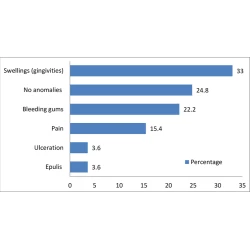
Background and Objective: Pregnancy is characterized by complex physiological and psychological changes that can affect the oral health of women. There is a paucity of literature on the oral health status of pregnant women in Cameroon. The objective of our study was to describe the oral health status of pregnant women attending the Laquintinie antenatal clinic in Douala, Cameroon. Methods: A descriptive cross-sectional study from January 2021 to June 2021 was conducted involving pregnant women who attended the antenatal clinic at Laquintinie Hospital and provided informed consent. A pretested questionnaire was administered in both French and English. Intraoral and extra-oral examinations were carried out to identify oro-facial pathologies. Results: Two hundred ninety-four pregnant women participated in our study, with ages ranging from 17 to 45 years (mean age = 26 years ± 5.1 standard deviation). Of these 144 (51.7%) were employed, 195 (70%) were married, and 168 (60.6%) had tertiary education. More than 20 (70%) were multiparous, and 111 (40%) were in the first trimester of pregnancy. Three-quarters, 210 (75%), had good knowledge of tooth cleaning, 182 (65.2%) brushed their teeth once daily, and 189 (68%) brushed only in the morning. Only a few 9 (3.2%) knew how to take care of their baby’s teeth, and 84 (30.1%) had been to a dentist. Halitosis was observed in 82 (29.3%), and all our participants had calculus deposits. The predominant oral pathologies were dental caries 168 (60.2%), gingivitis 143 (51.3%), and periodontitis 126 (45.2%). A third, 92 (33%) of the women had swelling of the gums during pregnancy, while 68 (24.5%) did not experience any change. In addition, 62 (22.2%) experienced bleeding, 43 (15.4%) pain, 10 (3.6%) ulcerations, and 10 (3.6%) epulis (pyogenic granuloma). Three out of four 210 (75.3%) of the women needed restoration for carious lesions. Conclusion and Global Health Implications: The oral health status of pregnant women in the Laquintinie antenatal clinic was poor, with a higher prevalence of dental caries and periodontal diseases ranging from mild to severe gingivitis and gingival epulis.
Downloads
Most read articles by the same author(s)
- Ashu Michael Agbor, Kepwa Florence Mekendja, Blek Che, Sudeshni Naidoo, Oral Health Status of People with Sickle Cell Disease at a Major Hospital in Cameroon , International Journal of Maternal and Child Health and AIDS: Vol. 14 No. Continuous (2025): International Journal of Maternal and Child Health and AIDS
- Anastasia Y. Bongajum, Pascal Foumane, Charlotte O. Moussi, Noel Vogue, Hycinth S. Banseka, Jujlius M. Nwobegahay, Martina L. Baye, Strengthening Maternal Death Surveillance Systems for Evidence-Based Decision Making in Sub-Saharan Africa: The Case of the Center Region in Cameroon , International Journal of Maternal and Child Health and AIDS: Vol. 10 No. 2 (2021): International Journal of Maternal and Child Health and AIDS
- Ashu Michael Agbor, Karpal Singh Sohal, Nguitewou Loith Nguimfack, Elvis Tarkang, Enow O’rock George, Sudeshni Naidoo, Oral Manifestations of HIV Infection and Dental Health Needs of Children with HIV Attending HIV Treatment Clinics in Western Cameroon , International Journal of Maternal and Child Health and AIDS: Vol. 13 No. Continuous (2024): International Journal of Maternal and Child Health and AIDS
Similar Articles
- Isaac Omo-Ehiabhi Eranga, COVID-19 Pandemic in Nigeria: Palliative Measures and the Politics of Vulnerability , Vol. 9 No. 2 (2020): International Journal of Maternal and Child Health and AIDS
You may also start an advanced similarity search for this article.
Published
How to Cite
Issue
Section
License
Copyright © 2025 Ashu Michael Agbor, Loyick Nguafack Zencha, Henri Essome, Che Bleck Ndikum, Pascal Foumane. Published by Global Health and Education Projects, Inc., USA.

This is an open-access article distributed under the terms of the Creative Commons Attribution-NonCommercial-ShareAlike 4.0 International License , which permits others to remix, transform, and build upon the work non-commercially, provided the original author is credited and the new creations are licensed under the same terms.