
Evaluation and Utility of a Family Information Table to Identify and Test Children at Risk for HIV in Kenya
DOI:
https://doi.org/10.21106/ijma.30Keywords:
- Family Information Table,
- Pediatrics,
- HIV/AIDS,
- Linkage,
- Kenya,
- HIV Testing
Abstract
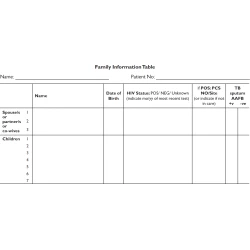
Background: Effective strategies to identify and screen children at risk for HIV are needed. The objectives of this study were to evaluate the utilization of a family information table (FIT) to identify and test at-risk children in Kenya and identify factors associated with child testing. Methods: A cross-sectional study was conducted among HIV-infected adults with children at five Kenyan clinics. HIV testing status for children aged ≤18 years was gathered from the patients’ FITs and compared to reports from in-person clinic visits as the gold standard. Generalized estimating equations were used to assess predictors for HIV testing of children adjusted for confounders and within parent correlation. Results: Our sample included 384 HIV-infected adults enrolled in care with 933 reported children. Overall, 323 FITs (84%) correctly listed all children in the family and 340 (89%) documented an HIV testing status (including untested) for all children. Seventy-five percent of parents verbally reported all children tested, compared to only 46% of FITs (OR=13.5, 95% CI 6.5-27.8). Verbal reports identified 739 (79%) children tested, with 55 (7.4%) HIV-positive and 17 (2.3%) HIV-exposed infants (HEI). Of 63 adults with HIV-positive children or HEI, 60 (95%) reported enrolling children into care. Likelihood that children had been tested was higher for younger children (≤4y vs. > 4y, aOR=2.0; 95% CI 1.4-2.9) and lower if the partner’s serostatus was unknown vs. seropositive (aOR=0.3; 95% CI: 0.1-0.8). Conclusions: Although the FIT may be a useful tool to identify children at risk for HIV, this study found underutilization by providers. To maximize impact of this tool, documentation of follow-up for untested and positive children is essential. Global Health Implications: Through early documentation of at-risk children and follow up of untested and infected children, the FIT may serve as an effective resource for improving HIV testing and linkage to care.
Downloads
Similar Articles
- Wah Wah Myint, Human Immunodeficiency Virus (HIV) Knowledge and Stigma: Findings from a Cross-sectional Survey , Vol. 15 (2026): International Journal of Maternal and Child Health and AIDS
- Kolawole A. Fasakin, Christopher T. Omisakin, Idowu O. Adebara, Wasiu A. Ajetunmobi, Adebayo A. Adeniyi, Ayodele J. Esan, Olufunke B. Bolaji, Oluwafemi D. Ajayi, Abayomi J. Afe, Assessment of PMTCT Success Rates Based on Antiretroviral Interventions and Feeding Options: A Prospective Cohort Study , Vol. 7 No. 2 (2018): International Journal of Maternal and Child Health and AIDS
- Faith Iretioluwa Olaniyi, Ayodele Ebenezer Owolabi, Gideon Temitope Olowe, Ololade Daniella Olunloyo, Eric Anuoluwapo Ogunleye, Ifeoluwapo Oluwafunke Kolawole, Perception, Pattern of Use, and Determinants of Family Planning Uptake Among Women of Childbearing Age in Ibadan, South West Nigeria , Vol. 15 (2026): International Journal of Maternal and Child Health and AIDS
- George Chidi Anwuri, Michael S. Dunn, Frederick Schulze, Determinants of Voluntary HIV/AIDS Counseling and Testing among Community College Students in the United States , Vol. 6 No. 2 (2017): International Journal of Maternal and Child Health and AIDS
- Agnes Langat, Tegan L. Callahan, Isabella Yonga, Boniface Ochanda, Anthony Waruru, Lucy W. Ng’anga, Abraham Katana, Brian Onyango, Benson Singa, Stephen Oyule, George Githuka, Lennah Omoto, Jane Muli, Thorkild Tylleskar, Surbhi Modi, Associations of Sociodemographic and Clinical Factors with Late Presentation for Early Infant HIV Diagnosis (EID) Services in Kenya , Vol. 10 No. 2 (2021): International Journal of Maternal and Child Health and AIDS
- Sorochi H. Iloanusi, Osaro O. Mgbere, Susan. M. Abughosh, Ekere J. Essien, HIV Non-Occupational Post Exposure Prophylaxis in Nigeria: A Systematic Review of Research Evidence and Practice , Vol. 8 No. 2 (2019): International Journal of Maternal and Child Health and AIDS
- Chaw Hay Thar, Young Hwa Lee, Young June Choe, Human Immunodeficiency Virus/Acquired Immunodeficiency Syndrome Knowledge and Attitude among Myanmar Women , Vol. 13 No. Continuous (2024): International Journal of Maternal and Child Health and AIDS
- Brianna L. Smith, Sara Zizzo, Anouk Amzel, Sarah Wiant, Molly C. Pezzulo, Sarah Konopka, Rachel Golin, Alexandra C. Vrazo, Integration of Neonatal and Child Health Interventions with Pediatric HIV Interventions in Global Health , Vol. 7 No. 1 (2018): International Journal of Maternal and Child Health and AIDS
- Margaret Omowaleola Akinwaare, Jonah Musa, Chizoma Millicent Ndikom, Determinants of Digitalized Antenatal Education Use among Pregnant Women Living with Human Immunodeficiency Virus in Nigeria , Vol. 15 (2026): International Journal of Maternal and Child Health and AIDS
- Wah W. Myint, David J. Washburn, Brian Colwell, Jay E. Maddock, Determinants of HIV Testing Uptake among Women (aged 15-49 years) in the Philippines, Myanmar, and Cambodia , Vol. 10 No. 2 (2021): International Journal of Maternal and Child Health and AIDS
You may also start an advanced similarity search for this article.
Published
How to Cite
Issue
Section
License
Copyright © 2015 Michelle Meyer, Molly Elmer-DeWitt, Cinthia Blat, Starley B Shade, Ijaa Kapule, Elizabeth Bukusi, Craig R Cohen, Lisa Abuogi. Published by Global Health and Education Projects, Inc., USA.

This is an open-access article distributed under the terms of the Creative Commons Attribution-NonCommercial-ShareAlike 4.0 International License , which permits others to remix, transform, and build upon the work non-commercially, provided the original author is credited and the new creations are licensed under the same terms.