
Introduction of Heat-Stable Carbetocin for Postpartum Hemorrhage Prevention in Public Sector Hospitals in Kenya: Provider Experience and Policy Insights
DOI:
https://doi.org/10.25259/IJMA_4_2024Keywords:
- HSC,
- Postpartum Hemorrhage,
- Uterotonics,
- World Health Organization,
- PPH Recommendations
Abstract
In Kenya, the leading cause of maternal deaths is obstetric hemorrhage (39.5%), with postpartum hemorrhage (PPH) accounting for 50% with quality of uterotonics as one of the biggest challenges. The World Health Organization (WHO) in 2018 included heat-stable carbetocin (HSC) for the prevention of PPH in settings where the quality of oxytocin cannot be guaranteed. Maintenance of the cold chain for uterotonics is a challenge. HSC does not require refrigeration, reducing pressure on the fragile cold chain infrastructure. The main objective was to understand PPH prevention knowledge, experience, and perspectives, including uterotonic use, by policymakers and healthcare providers (HCPs) in the public health sector in ten counties in Kenya. HCP knowledge, perception, and experience were assessed after the HSC introduction.
MethodsThe mixed methods study was implemented in 39 secondary and tertiary public hospitals from ten counties. Quantitative interviews targeting 171 HCPs at baseline and end-line were collected using REDCap software (v5.26.4) and analyzed using Stata version 17. Qualitative data was collected from 19 policymakers at the national, county, sub county, and health facility levels and analyzed using NVIVO 12.
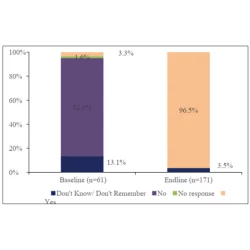
ResultsAt the end line, 98.8% had administered HSC for the prevention of PPH, while 96.5% of the HCPs were aware that their facilities had protocols/guidelines in place on the use of HSC. To enhance awareness of WHO recommendations on the use of HSC among HCPs, a top-down approach was used. Over 90% of HCPs agreed that HSC was easy to administer and distinguish from other uterotonics. Policymakers agreed that there was value in the HSC introduction in the public health sector that experiences cold chain challenges and recommended budgetary allocation.
Conclusion and Global Health ImplicationsThe findings demonstrate that HCP’s knowledge, perception, and experience coupled with the policymaker’s perspective is the key to the introduction of HSC in the public sector. Policymakers find value in introducing HSC as it alleviates challenges with the fragile cold chain systems. This study contributes to the global body of knowledge on the introduction of lifesaving commodities, which is anticipated to potentially improve PPH prevention and management, and hence reduce maternal mortality.
Downloads
Similar Articles
- Charles Chibuisi Ehiemere, Ishaku Adamu Akyala, Bisayo Adetuyi Ogundipe, Chukwuebuka Clement Nri-Ezedi, Peter Joseph Anzaku, Waryit Esther Yonah, Efe Mary Imokhai, Isaac Onyebuchi Okohu, Idowu Olapemi Makinde, Ngozi Miriam Chimzobam-Nnalue, Beyond Access: Behavior Change and Gendered Realities in the Adoption of Digital Health Tools for Maternal, Newborn, and Child Health in Nigeria , Vol. 15 (2026): International Journal of Maternal and Child Health and AIDS
- Olatunde Ayodele Amode, Damilola Kafayat Oyedele, Hadiza Salele, Olajumoke Adekeye, Uchenna Igbokwe, Lola Ameyan, Kayode Akin Afolabi, Olufunke Fasawe, Owens Wiwa, Cost-effectiveness and Budget Impact of Introducing Heat-stable Carbetocin for Postpartum Hemorrhage Prevention in Nigeria , Vol. 14 No. Continuous (2025): International Journal of Maternal and Child Health and AIDS
- Maria Vigil-Mallette, Daryle Pickens, Julliet Ogu, Deepa Dongarwar, Elizabeth Onugha, Hamisu M Salihu, Fifth Annual Summer Research Summit on Health Equity Organized by the Center of Excellence in Health Equity, Training and Research, Baylor College of Medicine, Houston, Texas 77030, USA on May 17, 2022 , Vol. 11 No. S2 (2022): International Journal of Maternal and Child Health and AIDS
- Amol Jamkhande, Bhagyashree P. Agre, Neelam Gavali, Anjali Rajesh Gaikwad, Sanpreet Singh Sachdev, Association Between Maternal Periodontitis and Preterm Low Birth Weight in Indian Populations: A Literature Review , Vol. 15 (2026): International Journal of Maternal and Child Health and AIDS
- Margaret Omowaleola Akinwaare, Jonah Musa, Chizoma Millicent Ndikom, Determinants of Digitalized Antenatal Education Use among Pregnant Women Living with Human Immunodeficiency Virus in Nigeria , Vol. 15 (2026): International Journal of Maternal and Child Health and AIDS
- Océane J. Parker, Duc Minh Duong, Thuy Thu Nguyen, Vui Thi Le, Utilization of Sexual and Reproductive Healthcare Services Among Young Women in Two Districts of Hanoi, Vietnam , Vol. 15 (2026): International Journal of Maternal and Child Health and AIDS
- Olatunde A. Amode, Omaye V. Negedu, Jessica T. Joseph, Uchenna Igbokwe Igbokwe, Olajumoke Adekeye, Damilola K. Oyedele, Hadiza Salele, Lola Ameyan, Kayode Afolabi, Olufunke Fasawe, Owens Wiwa, An Implementation Research Study on Uterotonics Use Patterns and Heat-stable Carbetocin Acceptability and Safety for Prevention of Postpartum Hemorrhage in Nigeria , Vol. 13 No. S1 (2024): International Journal of Maternal and Child Health and AIDS
- Nguyen Toan Tran, Awatta Walter Ochan, Jemelia Sake, Okpwoku Sukere, Willibald Zeck, Armando Seuc, Catrin Schulte-Hillen, Postpartum Hemorrhage in Humanitarian Settings: Heat-Stable Carbetocin and Tranexamic Acid Implementation Study in South Sudan , Vol. 13 No. S1 (2024): International Journal of Maternal and Child Health and AIDS
- Vaishali Alwadhi, Archana Mishra, Anil Nagendra, Devina Bajpayee, Naresh Chandra Joshi, Sachin Gupta, Harish Kumar, Introduction of Heat-Stable Carbetocin through a Public-Private Partnership Model in India: A Retrospective Study to Determine Feasibility and Its Optimal Use in Public Health Settings , Vol. 13 No. S1 (2024): International Journal of Maternal and Child Health and AIDS
- Sara Rushwan, Fatu Forna, Ferid Abbas Abubeker, Tesfaye Tufa, Tieba Millogo, Miriam Nakalembe, Kwame Adu-Bonsaffoh, Francis L. Moses, Lester Chinery, Gilda Piaggio, Metin Gülmezoglu, Integrating Heat-Stable Carbetocin and Tranexamic Acid for Prevention and Management of Postpartum Hemorrhage in Sub-Saharan Africa: A Five-Country Pilot Implementation Study , Vol. 13 No. S1 (2024): International Journal of Maternal and Child Health and AIDS
You may also start an advanced similarity search for this article.
Published
How to Cite
Issue
Section
License
Copyright © 2024 Daisy Ruto, Michael Muthamia, Edith Njeri, Freda Nyaga, Christine Muia, Morris Kiio, Jane Wausi. Published by Global Health and Education Projects, Inc., USA.

This is an open-access article distributed under the terms of the Creative Commons Attribution-NonCommercial-ShareAlike 4.0 International License , which permits others to remix, transform, and build upon the work non-commercially, provided the original author is credited and the new creations are licensed under the same terms.