
Child Development Monitoring in Well-baby Clinics in Kenya
DOI:
https://doi.org/10.21106/ijma.473Keywords:
- Child development,
- Development monitoring,
- Child health,
- Growth monitoring and promotion,
- Kenya,
- Screening
Abstract
Background: Maternal and child health (MCH) clinics represent an integrated approach for providing healthcare to pregnant women and children 0-59 months of age. Although MCH clinics are also charged with monitoring child development, which involves tracking developmental milestones, it is unclear how these services are provided or perceived within the clinic. This study aimed to describe self-reported knowledge, perceptions, and practice of developmental monitoring in selected MCH clinics in western Kenya.
Methods: This cross-sectional descriptive study was conducted within six clinics. We administered a descriptive survey to measure caregiver and healthcare staff attitudes towards and awareness of developmental monitoring; we also reviewed MCH booklets to identify services received at the clinic. Data collection occurred over a period of one day at each of the six clinic sites. The data were analyzed using descriptive statistics.
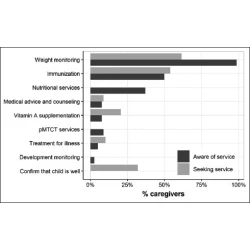
Results: During the study period, 78 caregiver-child pairs presented to the clinics and had their MCH booklets reviewed. The median child age was three months (interquartile range [IQR]: 1-8 months). Most caregivers were aware of weight monitoring and immunization services; however, when asked specifically about developmental monitoring, only 2.6% of caregivers were aware this service was available at the clinics. Nearly 80% of caregivers reported that they would be very interested in developmental monitoring services. Thirty-three MCH healthcare staff were interviewed about services provided and goals of clinical care. Fewer healthcare staff (60.6%) identified their roles in developmental monitoring compared to their roles in growth (90.9%) and nutritional monitoring (84.8%). Developmental milestones had not been recorded in any of the 78 MCH booklets. However, 78.1% of healthcare staff indicated support for developmental screening.
Conclusion and Global Health Implications: While developmental monitoring was valued by healthcare providers, it was not consistently performed at the six clinics in our study. We recommend further work to raise awareness about developmental monitoring and to measure the implications of increased caregiver knowledge and perceptions on developmental monitoring practice.
Downloads
Similar Articles
- Muhammad Adamu Abbas, Aisha A Abdullahi, Hassan A Murtala, Abubakar L Yusuf, Rahila A Mukhtar, Hamisu M Salihu, New Paradigm for Battling Hospital-Acquired Infections in Developing Countries , Vol. 14 No. Continuous (2025): International Journal of Maternal and Child Health and AIDS
- Abdallah Ibrahim, Anne Marie O’Keefe, Do Infant Birth Outcomes Vary Among Mothers With and Without Health Insurance Coverage in Sub-Saharan Africa? Findings from the National Health Insurance and Cash and Carry Eras in Ghana, West Africa , Vol. 2 No. 2 (2014): International Journal of Maternal and Child Health and AIDS
- Armand Duclaire Kemo, Bruno Kenfack, Jerome Ateudjieu, Maternal Deaths and Complications: Documentation of Parameters on the Partographs Used by Health Care Providers in Four Hospitals in West Cameroon , Vol. 14 No. Continuous (2025): International Journal of Maternal and Child Health and AIDS
- Elizabeth Armstrong-Mensah, David-Praise Ebiringa, Kaleb Whitfield, Jake Coldiron, Genital Chlamydia Trachomatis Infection: Prevalence, Risk Factors and Adverse Pregnancy and Birth Outcomes in Children and Women in sub-Saharan Africa , Vol. 10 No. 2 (2021): International Journal of Maternal and Child Health and AIDS
- David Rakotonandrasana Harimbola, Kaori Mizumoto, Individual and Household Risk Factors for Severe Acute Malnutrition among Under-Five Children in the Analamanga Region, Madagascar , Vol. 7 No. 1 (2018): International Journal of Maternal and Child Health and AIDS
- Md Nazrul Islam Mondai, Md Monzur Morshad Nasir Ullah, Md Rafiqul Islam, Md Shafiur Rahman, Md Nuruzzaman Khan, Kazi Mohiuddin Ahmed, Mohammad Shariful Islam, Sociodemographic and Health Determinants of Inequalities in Life Expectancy in Least Developed Countries , Vol. 4 No. 1 (2015): International Journal of Maternal and Child Health and AIDS
- Sorochi H. Iloanusi, Osaro O. Mgbere, Susan. M. Abughosh, Ekere J. Essien, HIV Non-Occupational Post Exposure Prophylaxis in Nigeria: A Systematic Review of Research Evidence and Practice , Vol. 8 No. 2 (2019): International Journal of Maternal and Child Health and AIDS
- Nnennaya N. Kalu-Umeh, Mohammed N. Sambo N. Sambo, Suleiman H. Idris, Abubakar M. Kurfi, Costs and Patterns of Financing Maternal Health Care Services in Rural Communities in Northern Nigeria: Evidence for Designing National Fee Exemption Policy , Vol. 2 No. 1 (2013): International Journal of Maternal and Child Health and AIDS
- Rajesh Narwal, Lu Gram, Has the Rate of Reduction in Infant Mortality Increased in India Since the Launch of National Rural Health Mission? Analysis of Time Trends 2000-2009 with Projection to 2015 , Vol. 2 No. 1 (2013): International Journal of Maternal and Child Health and AIDS
- Veronica B. Ajewole-Mwema, Nkechi U. Ogboh, Dolores Ramirez, Olanike A. Shamonda, Kassie L. Thompson, Sneha George, Deepa Dongarwar, Polly Niravath, Mobile Mammography Outreach in Communities with Unmet Health Needs: Assessment of Appointment Outcomes and Operational Insights from Texas, United States , Vol. 14 No. Continuous (2025): International Journal of Maternal and Child Health and AIDS
<< < 2 3 4 5 6 7 8 9 10 11 > >>
You may also start an advanced similarity search for this article.
Published
How to Cite
Issue
Section
License
Copyright © 2021 Eren Oyungu, Anna Roose, Ananda R. Ombitsa, Rachel C. Vreeman, Megan S. McHenry. Published by Global Health and Education Projects, Inc., USA.

This is an open-access article distributed under the terms of the Creative Commons Attribution-NonCommercial-ShareAlike 4.0 International License , which permits others to remix, transform, and build upon the work non-commercially, provided the original author is credited and the new creations are licensed under the same terms.