
Child Development Monitoring in Well-baby Clinics in Kenya
DOI:
https://doi.org/10.21106/ijma.473Keywords:
- Child development,
- Development monitoring,
- Child health,
- Growth monitoring and promotion,
- Kenya,
- Screening
Abstract
Background: Maternal and child health (MCH) clinics represent an integrated approach for providing healthcare to pregnant women and children 0-59 months of age. Although MCH clinics are also charged with monitoring child development, which involves tracking developmental milestones, it is unclear how these services are provided or perceived within the clinic. This study aimed to describe self-reported knowledge, perceptions, and practice of developmental monitoring in selected MCH clinics in western Kenya.
Methods: This cross-sectional descriptive study was conducted within six clinics. We administered a descriptive survey to measure caregiver and healthcare staff attitudes towards and awareness of developmental monitoring; we also reviewed MCH booklets to identify services received at the clinic. Data collection occurred over a period of one day at each of the six clinic sites. The data were analyzed using descriptive statistics.
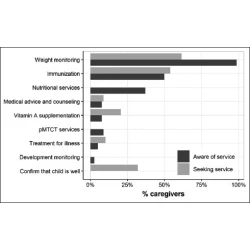
Results: During the study period, 78 caregiver-child pairs presented to the clinics and had their MCH booklets reviewed. The median child age was three months (interquartile range [IQR]: 1-8 months). Most caregivers were aware of weight monitoring and immunization services; however, when asked specifically about developmental monitoring, only 2.6% of caregivers were aware this service was available at the clinics. Nearly 80% of caregivers reported that they would be very interested in developmental monitoring services. Thirty-three MCH healthcare staff were interviewed about services provided and goals of clinical care. Fewer healthcare staff (60.6%) identified their roles in developmental monitoring compared to their roles in growth (90.9%) and nutritional monitoring (84.8%). Developmental milestones had not been recorded in any of the 78 MCH booklets. However, 78.1% of healthcare staff indicated support for developmental screening.
Conclusion and Global Health Implications: While developmental monitoring was valued by healthcare providers, it was not consistently performed at the six clinics in our study. We recommend further work to raise awareness about developmental monitoring and to measure the implications of increased caregiver knowledge and perceptions on developmental monitoring practice.
Downloads
Similar Articles
- Romuladus E. Azuine, Sussan E. Ekejiuba, Gopal K. Singh, Magnus A. Azuine, Ebola Virus Disease Epidemic: What Can the World Learn and Not Learn from West Africa? , Vol. 3 No. 1 (2015): International Journal of Maternal and Child Health and AIDS
- Foluke Adenike Olatona, Jesupelumi Oreoluwa Adenihun, Sunday Adedeji Aderibigbe, Oluwafunmilayo Funke Adeniyi, Complementary Feeding Knowledge, Practices, and Dietary Diversity among Mothers of Under-Five Children in an Urban Community in Lagos State, Nigeria , Vol. 6 No. 1 (2017): International Journal of Maternal and Child Health and AIDS
- Gopal K. Singh, Romuladus E. Azuine, Mohammad Siahpush, Shanita D. Williams, Widening Geographical Disparities in Cardiovascular Disease Mortality in the United States, 1969-2011 , Vol. 3 No. 2 (2015): International Journal of Maternal and Child Health and AIDS
- Comfort Z. Olorunsaiye, Larissa R. Brunner Huber, Samira P. Ouedraogo, Interbirth Intervals of Immigrant and Refugee Women in the United States: A Cross-Sectional Study , Vol. 12 No. 1 (2023): International Journal of Maternal and Child Health and AIDS
- Christina Kinnevey, Michael Kawooya, Tonny Tumwesigye, David Douglas, Sarah Sams, Addressing Obstetrical Challenges at 12 Rural Ugandan Health Facilities: Findings from an International Ultrasound and Skills Development Training for Midwives in Uganda , Vol. 5 No. 1 (2016): International Journal of Maternal and Child Health and AIDS
- Vaishali Alwadhi, Archana Mishra, Anil Nagendra, Devina Bajpayee, Naresh Chandra Joshi, Sachin Gupta, Harish Kumar, Introduction of Heat-Stable Carbetocin through a Public-Private Partnership Model in India: A Retrospective Study to Determine Feasibility and Its Optimal Use in Public Health Settings , Vol. 13 No. S1 (2024): International Journal of Maternal and Child Health and AIDS
- Varun Alwadhi, Naresh Chandra Joshi, Prashant Kumar Saboth, Raghavendra Narayan Mishra, Kuldeep Martolia, Saurabh Bhargava, Sachin Gupta, Harish Kumar, Management of Newborn Respiratory Distress Using CPAP: Capacity and Readiness of Public Health Facilities in High-Focus Aspirational Districts of India , Vol. 14 No. Continuous (2025): International Journal of Maternal and Child Health and AIDS
- Johnbull Egharevba, Jennifer Pharr, Brian van Wyk, Echezona Ezeanolue, Factors Influencing the Choice of Child Delivery Location among Women Attending Antenatal Care Services and Immunization Clinic in Southeastern Nigeria , Vol. 6 No. 1 (2017): International Journal of Maternal and Child Health and AIDS
- Kalaivani Mani, Sada Nand Dwivedi, Ravindra Mohan Pandey, Determinants of Under-Five Mortality in Rural Empowered Action Group States in India: An Application of Cox Frailty Model , Vol. 1 No. 1 (2012): International Journal of Maternal and Child Health and AIDS
- Titilayo Olaoye, Oyewole O. Oyerinde, Oluwatoyin J. Elebuji, Oluwapelumi Ologun, Knowledge, Perception and Management of Pre-eclampsia among Health Care Providers in a Maternity Hospital , Vol. 8 No. 2 (2019): International Journal of Maternal and Child Health and AIDS
<< < 5 6 7 8 9 10 11 12 13 14 > >>
You may also start an advanced similarity search for this article.
Published
How to Cite
Issue
Section
License
Copyright © 2021 Eren Oyungu, Anna Roose, Ananda R. Ombitsa, Rachel C. Vreeman, Megan S. McHenry. Published by Global Health and Education Projects, Inc., USA.

This is an open-access article distributed under the terms of the Creative Commons Attribution-NonCommercial-ShareAlike 4.0 International License , which permits others to remix, transform, and build upon the work non-commercially, provided the original author is credited and the new creations are licensed under the same terms.