
Child Development Monitoring in Well-baby Clinics in Kenya
DOI:
https://doi.org/10.21106/ijma.473Keywords:
- Child development,
- Development monitoring,
- Child health,
- Growth monitoring and promotion,
- Kenya,
- Screening
Abstract
Background: Maternal and child health (MCH) clinics represent an integrated approach for providing healthcare to pregnant women and children 0-59 months of age. Although MCH clinics are also charged with monitoring child development, which involves tracking developmental milestones, it is unclear how these services are provided or perceived within the clinic. This study aimed to describe self-reported knowledge, perceptions, and practice of developmental monitoring in selected MCH clinics in western Kenya.
Methods: This cross-sectional descriptive study was conducted within six clinics. We administered a descriptive survey to measure caregiver and healthcare staff attitudes towards and awareness of developmental monitoring; we also reviewed MCH booklets to identify services received at the clinic. Data collection occurred over a period of one day at each of the six clinic sites. The data were analyzed using descriptive statistics.
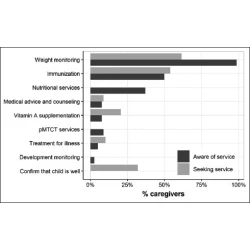
Results: During the study period, 78 caregiver-child pairs presented to the clinics and had their MCH booklets reviewed. The median child age was three months (interquartile range [IQR]: 1-8 months). Most caregivers were aware of weight monitoring and immunization services; however, when asked specifically about developmental monitoring, only 2.6% of caregivers were aware this service was available at the clinics. Nearly 80% of caregivers reported that they would be very interested in developmental monitoring services. Thirty-three MCH healthcare staff were interviewed about services provided and goals of clinical care. Fewer healthcare staff (60.6%) identified their roles in developmental monitoring compared to their roles in growth (90.9%) and nutritional monitoring (84.8%). Developmental milestones had not been recorded in any of the 78 MCH booklets. However, 78.1% of healthcare staff indicated support for developmental screening.
Conclusion and Global Health Implications: While developmental monitoring was valued by healthcare providers, it was not consistently performed at the six clinics in our study. We recommend further work to raise awareness about developmental monitoring and to measure the implications of increased caregiver knowledge and perceptions on developmental monitoring practice.
Downloads
Similar Articles
- Alexander Suuk Laar, Veioshnee Govender, Individual and Community Perspectives, Attitudes, and Practices to Mother-to-Child-Transmission and Infant Feeding among HIV-Positive Mothers in Sub-Saharan Africa: A Systematic Literature Review , Vol. 2 No. 1 (2013): International Journal of Maternal and Child Health and AIDS
- Gopal K. Singh, Stella M. Yu, Infant Mortality in the United States, 1915-2017: Large Social Inequalities have Persisted for Over a Century , Vol. 8 No. 1 (2019): International Journal of Maternal and Child Health and AIDS
- Anjali Pal, Sunil Kumar Panigrahi, Pragyan Paramita Parija, Sagarika Majumdar, Geospatial Analysis of Parental Healthcare-Seeking Behavior in the Vicinity of Multispecialty Hospital in India , Vol. 13 No. Continuous (2024): International Journal of Maternal and Child Health and AIDS
- Raees A. Shaikh, Mohammad Siahpush, Gopal K. Singh, Melissa Tibbits, Socioeconomic Status, Smoking, Alcohol use, Physical Activity, and Dietary Behavior as Determinants of Obesity and Body Mass Index in the United States: Findings from the National Health Interview Survey , Vol. 4 No. 1 (2015): International Journal of Maternal and Child Health and AIDS
- Gopal K. Singh, Anagha Lokhande, Romuladus E. Azuine, Global Inequalities in Youth Mortality, 2007-2012 , Vol. 3 No. 1 (2015): International Journal of Maternal and Child Health and AIDS
- Alana F. Hairston, Emily A. Bobrow, Christian S. Pitter, Towards the Elimination of Pediatric HIV: Enhancing Maternal, Sexual, and Reproductive Health Services , Vol. 1 No. 1 (2012): International Journal of Maternal and Child Health and AIDS
- Sudip Bhattacharya, Sandip Bhattacharya, Vidisha Vallabh, Roy Rillera Marzo, Ruchi Juyal, Ozden Gokdemir, Digital Well-being Through the Use of Technology–A Perspective , Vol. 12 No. 1 (2023): International Journal of Maternal and Child Health and AIDS
- Ashu Michael Agbor, Loyick Nguafack Zencha, Henri Essome, Che Bleck Ndikum, Pascal Foumane, Oral Health Status of Pregnant Women Attending Antenatal Clinic in Cameroon , Vol. 14 No. Continuous (2025): International Journal of Maternal and Child Health and AIDS
- Barbara Burmen, Gregory Kurtzman, Anthony A Olashore, Leyla Baghirova Busang, Ohemaa Poku, Phenyo Morakanyane, Ontibile Tshume, Onkemetse Phoi, Mogomotsi Matshaba, Elizabeth D Lowenthal, Knashawn H Morales, Merrian J Brooks, HIV Virologic Suppression and Mental Well-being in Adolescents and Young Adults Living with HIV , Vol. 14 No. Continuous (2025): International Journal of Maternal and Child Health and AIDS
- Romuladus E. Azuine, Sussan E. Ekejiuba, Gopal K. Singh, Magnus A. Azuine, Ebola Virus Disease Epidemic: What Can the World Learn and Not Learn from West Africa? , Vol. 3 No. 1 (2015): International Journal of Maternal and Child Health and AIDS
<< < 4 5 6 7 8 9 10 11 12 13 > >>
You may also start an advanced similarity search for this article.
Published
How to Cite
Issue
Section
License
Copyright © 2021 Eren Oyungu, Anna Roose, Ananda R. Ombitsa, Rachel C. Vreeman, Megan S. McHenry. Published by Global Health and Education Projects, Inc., USA.

This is an open-access article distributed under the terms of the Creative Commons Attribution-NonCommercial-ShareAlike 4.0 International License , which permits others to remix, transform, and build upon the work non-commercially, provided the original author is credited and the new creations are licensed under the same terms.